Can Chatbots in Healthcare Actually Improve Patient Outcomes?

Conversational artificial intelligence (AI) in healthcare can improve patient outcomes in selected use cases, most consistently in medication and supplement adherence, chronic disease self-management, and low-intensity behavioral support. Benefits vary by condition, tool design, patient population, and whether the tool is integrated into a clinician-supervised workflow. A systematic review of chatbot interventions for chronic illness found favorable patient acceptance alongside limited and inconsistent efficacy data. (6)
A patient leaves the office with a supplement protocol, a lab follow-up, and a plan to change how they eat and sleep, and whether any of it works is decided over the next several weeks at home. Conversational AI is being marketed to fill that gap with reminders, check-ins, and answers a clinic cannot deliver by hand for every patient. This article reviews where evidence supports measurable gains and where current claims remain less certain.
Ready to start delivering better patient care?
Join 125,000 healthcare providers who rely on Fullscript to dispense top-quality supplements and labs to their patients.
Key takeaways
- Conversational AI in healthcare shows the most consistent outcome gains in medication and supplement adherence and in chronic disease self-management, with smaller, small-to-moderate benefits in low-intensity mental health support.
- AI chatbots in healthcare extend a practitioner's reach into the time between visits, when most of a treatment plan succeeds or fails.
- Reported effects vary by condition, population, tool design, and workflow integration.
- Conversational AI for healthcare works best when it is layered onto an existing care workflow and the practitioner receives the data the tool collects.
- One major risk is deployment without clinical oversight, which can create the appearance of care while missing what a patient actually needs.
Defining conversational AI in healthcare
Conversational AI in healthcare is a category, not a single product, and the label covers tools that do very different things. The distinctions affect which evidence applies, because findings from one design rarely transfer to another.
What conversational AI for healthcare actually is (and is not)
Conversational AI in healthcare refers to systems that use natural language processing (NLP) to interpret what a patient types or says, hold a back-and-forth exchange, and return a contextual response rather than a fixed menu answer. Healthcare-grade versions add requirements consumer chatbots lack. They interpret clinical context, include guardrails that stop the tool short of advice it should not give, and protect protected health information (PHI) under the Health Insurance Portability and Accountability Act (HIPAA). A systematic review of AI-powered chatbots for chronic illness describes these tools as relying on natural language processing and multimodal interaction. (6)
Several tools are marketed as healthcare chatbots without meeting the definition of conversational AI. A basic FAQ bot matches keywords to canned replies and cannot follow a thread. An interactive voice response phone tree routes callers through preset options with no comprehension of the words. A clinician-facing generative copilot drafts notes for a provider rather than speaking with the patient. The first question about any tool is which of these it actually is.
Types of AI chatbots deployed in clinical settings
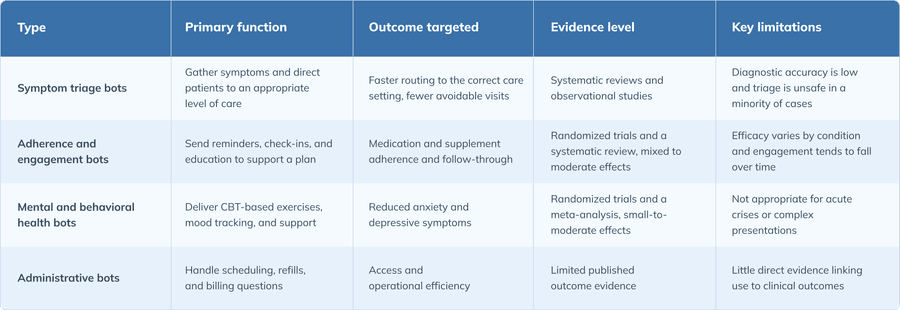
AI chatbots in healthcare fall into four groups, and the group determines what outcome the tool can affect. Symptom triage bots collect symptoms and suggest where to seek care, and their accuracy has been tested against physician judgment in the emergency department (ED). (4) Adherence and engagement bots send reminders, check-ins, and education, and they carry randomized evidence for medication behavior. (8) Mental and behavioral health bots deliver cognitive behavioral therapy (CBT) exercises and mood tracking, with meta-analytic evidence in younger adults. (3) Administrative bots handle scheduling, refills, and billing, and carry the least outcome evidence of the four.
A single product often combines more than one of these functions, so identifying the primary function is the first step in judging a tool's claims. Table 1 compares the four types.
Table 1. AI chatbot types in healthcare
Where the evidence shows chatbots improving patient outcomes
The strongest evidence is in adherence, chronic disease self-management, and low-intensity behavioral health support, where care depends on repeated contact between appointments rather than a single intervention. Triage evidence is more mixed.
Adherence and treatment follow-through
Adherence is one of the better-supported use cases, partly because reminders address a common point of failure in treatment plans. A systematic review of chatbot interventions for chronic illness found favorable patient acceptance across conditions, with efficacy evidence limited by small, inconsistently documented trials. (6) A stronger single result comes from a randomized trial of a voice-based conversational AI for insulin management, in which adherence reached 82.9 percent in the AI group versus 50.2 percent under standard care. (8) Patients rarely abandon a regimen in one decision. They miss a dose during a busy week, run out without reordering, and drift off the plan, and a well-timed prompt interrupts that drift.
In integrative practice, automated adherence support applies to multi-product supplement protocols with staggered dosing that lapse easily. Automated engagement tools perform the same reminder function as a conversational agent. Fullscript's adherence tools include dose reminders, auto refills, and a patient mobile app, and Fullscript reports that patients using auto refills are 70 percent more likely to order their next product and that mobile app users are 34 percent more likely to refill.
These are Fullscript platform metrics rather than peer-reviewed outcomes, and they reflect ordering and refill behavior on the platform rather than clinical endpoints. Both the published evidence and the Fullscript platform metrics point to the same mechanism: repeated contact when patients are most likely to miss a dose, delay a refill, or stop following the plan.
Chronic disease self-management
Chronic conditions such as diabetes, hypertension, and chronic obstructive pulmonary disease (COPD) benefit from daily behavioral support that a clinic cannot staff for every patient. In a randomized trial of voice-based conversational AI for basal insulin titration, participants reached their optimal insulin dose in a median of 15 days versus more than 56 days under usual care, were more likely to achieve glycemic control, and reported less diabetes-related distress. (8) The tool checked a value daily and adjusted guidance in response, at a frequency a human team could not match.
Conversational tools extend beyond diabetes to other chronic conditions. A chatbot can prompt a blood pressure log, ask a patient with COPD whether their breathing has changed, or run a symptom diary that surfaces a flare earlier. A systematic review of chatbots for chronic illness found adoption for self-management across several conditions, covering education, behavior change, and self-care, while noting that rigorous outcome data remain limited. (6) This fits the functional-medicine model, which already treats care as continuous management rather than episodic visits, with the chatbot maintaining daily contact between appointments.
Mental health and behavioral interventions
CBT-based chatbots, including studied tools such as Woebot and Wysa, are the most rigorously tested category, and the effects are modest. A meta-analysis of 31 randomized trials in adolescents and young adults found small-to-moderate reductions in mental distress, with a standardized effect near a third of a standard deviation and separate significant effects for depressive and anxiety symptoms. (3) Retrieval-based systems that draw on vetted content produced more consistent results than generative ones, and engagement predicted benefit more than any other design feature.
Mental health chatbot trial results vary by tool and comparator. A randomized trial of a CBT chatbot for subclinical anxiety and depression found improvement in the chatbot group, but a simple self-help book produced comparable gains, showing that an inexpensive control can match the tool. (5) These chatbots are built for mild to moderate presentations, are not appropriate for acute psychiatric crises or complex trauma, and in well-built versions route any disclosure of suicidal ideation to a crisis line. Within those limits, they can extend low-intensity support to patients who would otherwise wait weeks for it.
Pre-visit triage and care navigation
Symptom checkers aim at an indirect outcome, which is getting a patient to the right level of care faster and avoiding unnecessary visits. Their accuracy is uneven. A systematic review of digital symptom checkers found primary-diagnosis accuracy from 19 to 37.9 percent and triage accuracy from 48.8 to 90.1 percent, higher than diagnosis but variable across tools and conditions. (11) A second systematic review reached a similar conclusion, with most tools showing suboptimal triage and accuracy shifting with the severity of the presentation. (10)
Direct patient use of symptom checkers has added safety concerns. When patients used a leading symptom checker in an emergency department study, independent physicians judged 14 percent of its triage recommendations unsafe or too risky, even though its diagnostic sensitivity roughly matched the physicians reviewing the same data. (4) A symptom checker can shorten the path to care and structure a pre-visit intake, and its output should be reviewed by a clinician rather than used in place of one, especially for anything potentially urgent.
Where chatbots fall short (and what the skeptics get right)
The main concerns are supported by the research: loss of clinical nuance, over-automation, inequitable access, and privacy risk.
Clinical nuance chatbots cannot replicate
Chatbots cannot perform whole-person clinical assessment. They work from text and structured input, and they miss the visual and vocal cues a clinician uses to form an impression, such as affect, body language, and the hesitations that prompt a follow-up question. In an emergency department evaluation of a symptom checker, independent physicians rated a share of triage recommendations unsafe based on the same patient-entered data, an error the tool cannot detect on its own. (4)
Collecting information is different from interpreting it. A chatbot can gather a structured history efficiently, often more completely than a rushed intake form, and the judgment about what that history means remains with the clinician. This keeps the chatbot in an intake role and leaves clinical interpretation with the practitioner.
Risk of over-automation and patient abandonment
Over-automation harms patients when a chatbot replaces human follow-up rather than supporting it. A patient who reaches only a bot when they wanted a person can disengage, and trust in digital health tools is fragile enough that one poor early interaction can close a patient off from tools that might help later. A cross-sectional survey of chatbot acceptability found patients rated chatbots least acceptable for severe health issues and preferred a clinician, or a clinician-and-chatbot combination, for anything serious. (7)
Liability depends on how far a chatbot is allowed to act without oversight. A chatbot that moves from support into diagnostic advice raises questions of accountability, and a systematic review of symptom checkers flagged patient-safety hazards when these tools are relied on in place of clinical judgment. (11) Every automated path should include a visible route back to a person.
Equity, access, and literacy barriers
Digital tools can widen access gaps when they only reach the technologically comfortable. Digital literacy, primary language, and device access vary across populations, and so does readiness to use a new tool. A study of telehealth readiness among older adults in the United States found about two in three were ready, with significantly lower readiness among rural residents, financially strained individuals, and Black and Hispanic older adults compared with non-Hispanic White peers. (1) The authors traced the gaps to device ownership and training, not only broadband access.
A chatbot deployed without accounting for these differences can serve the patients who need the least help and miss those who need the most. Responsible design offers the interaction in more than one language, keeps the reading level plain, does not assume the newest device, and leaves a clear path to a human. For a mixed patient population, identifying who a tool excludes is as important as measuring who it helps.
Data privacy and patient trust
HIPAA does not automatically cover a consumer health app, which affects how patient data are protected. A legal analysis of AI chatbots and HIPAA explains that large language model developers fall under HIPAA only when they process protected health information on behalf of a covered entity, becoming business associates or subcontractors, which leaves many direct-to-consumer tools outside its protections. (9)
The lack of automatic HIPAA coverage has produced enforcement action. The Federal Trade Commission (FTC) ordered an online counseling service to pay 7.8 million dollars after it shared users' email addresses and mental health questionnaire responses with advertisers while displaying a seal implying HIPAA compliance it did not have. (2) Integrative patients often disclose sensitive details about mental health, gastrointestinal symptoms, hormones, and sexual health, so before offering a tool a practitioner should confirm whether it is a HIPAA business associate, what it does with patient input, and who else can access it.
Designing conversational AI that supports the whole person care model
In integrative practice, a chatbot should support the practitioner-patient relationship rather than automate it. That goal shapes how a tool should be built and where it fits in a practice, because tools that replace the clinician and tools that extend the clinician can look similar in a demo and differ in practice.
Extending the practitioner's presence between visits
Conversational AI is most useful between visits, maintaining contact and prompting the daily actions a plan depends on. It can reinforce the reasoning behind a treatment plan and answer low-stakes questions that would otherwise wait for a portal message or go unasked. A meta-analysis of chatbot trials in younger adults found that design features such as reminders and dialogue structure shaped outcomes, and that engagement predicted benefit more than any other factor. (3)
A tool patients keep using is more useful than one they abandon after a week. Sustained, low-friction patient engagement is worth more than a long feature list, and a practical test of a between-visit tool is whether patients still use it after several weeks.
Closing the adherence loop with automated engagement
Fullscript's whole person care cycle moves from capturing patient data, to writing plans, to offering products, to continuing care, and conversational engagement applies at that final stage to support adherence and reduce administrative load. Cost and friction both affect follow-through. Practitioners commonly cite price as the main reason patients stop a supplement routine, and Fullscript reports that patients with an auto refill discount are twice as likely to schedule refills.
The patient mobile app provides a low-effort touchpoint, available on iOS, where patients can view their plan, track what they are taking, set dose reminders, and reorder. These tools support adherence rather than replace the practitioner, and they keep a plan active through the weeks when follow-through tends to lapse. A practice already using automated refills and reminders can extend the same workflow with a conversational tool rather than adding a separate one.
Keeping clinical oversight in the loop
Effective implementations return information to the practitioner rather than holding it inside the app. When a tool flags missed doses, a reported symptom, or a drop in adherence, the provider can use that signal to open the next visit already knowing where the plan slipped. A legal analysis of AI chatbots ties accountability to how patient data are handled and how far a tool acts without a human involved, which supports keeping the clinician informed. (9)
Fullscript's practitioner-facing adherence insights apply this model, surfacing compliance patterns so a provider can act on them rather than leaving the data unreviewed. The feedback loop should inform the next clinical conversation instead of operating separately from care.
Evaluating and adopting AI chatbots in your practice
A chatbot should be evaluated like any other tool added to patient care. A tool that fits one practice can be wrong for another with a different panel or workflow, so the steps below keep the decision grounded in outcomes rather than features.
Questions to ask before implementing conversational AI
Before implementation, the practice should answer five questions:
- What outcome am I trying to improve, whether adherence, engagement, triage, or education, and how will I know if it moved?
- Is the tool validated for my patient population, rather than for a group that looks nothing like the people in my waiting room?
- How does it integrate with my current workflow and electronic health record (EHR), and does it add steps or remove them?
- What happens when the bot meets a situation outside its scope, and does it escalate to a human quickly and clearly?
- How are patient data stored, shared, and protected, and is the vendor a HIPAA business associate?
Outcome selection and population fit should be answered before workflow or vendor details. A systematic review of symptom checkers documented how much accuracy varies between tools and conditions, which is why validation for the specific intended use is not optional. (11) A legal analysis of AI chatbots and HIPAA makes the parallel point about data, where protection depends on the contractual arrangement behind the tool rather than its marketing. (9)
Starting with low-risk, high-value use cases
The safest entry points are low-risk, high-value tasks, such as appointment reminders, supplement routine check-ins, and patient education delivery. None requires the tool to make a clinical judgment, and each addresses a friction the practice already has. Starting here builds practitioner comfort and patient trust, and it shows whether patients in a specific panel will engage before more is asked of the tool.
Complexity can be added afterward, once the basics work and the failure modes are understood. Practitioners already using automated engagement have a foundation, so a sensible first step is to optimize the supplement plans and adherence tools already in the workflow before adding new technology. A staged rollout, one use case at a time, also makes it easier to see which addition is helping.
Measuring what matters
A chatbot should be retained only when it improves a meaningful outcome. Useful measures include adherence rates, refill frequency, patient-reported satisfaction, appointment show rates, and the clinical markers relevant to the condition, tracked over time. Message volume alone is not an outcome measure and says nothing about whether a patient is healthier. Usage metrics count what the tool does, such as messages sent or sessions opened, while outcome metrics count what changes for the patient, such as a refill completed, a symptom score improved, or an appointment kept.
A systematic review of chatbot interventions found that many studies could not demonstrate efficacy because they lacked rigorous outcome evaluation, the same gap a practice creates when it measures usage instead of results. (6) Tying each metric to an outcome, and reassessing on a set schedule such as quarterly, keeps the evaluation focused on whether patients are following through.
Frequently asked questions about AI chatbots in healthcare
Do AI chatbots improve patient adherence?
AI chatbots can improve patient adherence in specific contexts. A randomized trial found substantially higher medication adherence with a conversational AI tool, though a systematic review cautions that overall efficacy evidence is still limited and varies by condition. (8)(6)
Are healthcare chatbots HIPAA compliant?
Healthcare chatbot HIPAA compliance depends on implementation, not on the technology itself. A legal analysis explains that a chatbot is covered by HIPAA only when it handles protected health information on behalf of a covered entity, so many consumer tools fall outside its protections. (9)
Can chatbots replace a doctor or healthcare provider?
No, healthcare chatbots should not replace doctors or qualified healthcare providers. The evidence supports augmentation rather than replacement, and an emergency department study found that a symptom checker's triage advice was sometimes unsafe without clinician review. (4)
What is conversational AI in healthcare used for?
Conversational AI in healthcare is used for symptom triage, adherence and engagement support, patient education, and administrative tasks such as scheduling and refills. A systematic review documents these applications and notes that outcome evidence is strongest for engagement and self-management. (6)
Are patients comfortable talking to healthcare chatbots?
Patient comfort with healthcare chatbots is mixed and varies by age and condition. A survey of adults over 55 found many were skeptical of chatbots for medical advice, and a separate survey found acceptability was higher for stigmatized concerns and lower for severe ones. (12)(7)
Ready to start delivering better patient care?
Join 125,000 healthcare providers who rely on Fullscript to dispense top-quality supplements and labs to their patients.