Can a Physician Assistant Order Labs? Scope, Acceptance, and Follow-Up


A laboratory requisition arrives signed by a physician assistant, and someone has to decide within minutes whether to draw the specimen, route the order for a co-signature, or hold it for verification. That decision repeats every day across primary care, urgent care, telehealth visits, and specialty clinics. Whether a physician assistant can order labs is rarely a clean yes or no, because the answer turns on where the patient is, how the practice is structured, and which payer will receive the claim.
Physician assistants (PAs), increasingly titled physician associates, are licensed clinicians trained to order and interpret diagnostic testing as part of patient care. The American Academy of PAs adopted physician associate as the profession's official title in 2021, though most statutes, payer materials, and laboratory policies still use physician assistant. (2) Ordering authority, laboratory acceptance, payer coverage, and follow-up responsibility are four separate questions, and each is governed by a different set of rules.
A physician assistant can often order lab tests. Whether a specific PA lab order is valid and usable depends on state law, the PA's scope of practice, the supervision or collaboration arrangement, facility policy, payer requirements, medical necessity documentation, and the workflow that manages the result.
Key takeaways:
- A physician assistant can often order labs, but the validity of any given order depends on state law, the PA's scope, the practice arrangement, facility policy, laboratory acceptance, and payer requirements.
- Payment and coverage are separate from the legal authority to order, and they vary across Medicare, Medicaid, commercial insurance, and self-pay, so verification belongs with each payer.
- Safe operational use rests on clear result routing, abnormal-result escalation, documentation of clinical intent, and closed-loop follow-up.
Ready to start delivering better patient care?
Join 125,000 healthcare providers who rely on Fullscript to dispense top-quality supplements and labs to their patients.
What determines whether a physician assistant can order labs
Physician assistants can order many laboratory tests, with that authority shaped by law and setting rather than granted automatically. This chapter explains the conditions that decide whether a given PA lab order holds up.
Conditional authority for physician assistant lab orders
PA lab ordering is generally permitted when it falls within the PA's licensed scope and the applicable state law. The boundaries of each PA's scope are set by education and experience, state law, employer and facility policy, and patient needs, and PA training specifically includes ordering and interpreting laboratory tests. (1) Medicare reflects the same logic, allowing a nonphysician practitioner to order diagnostic tests to the extent state scope of practice permits. (7)
Because the conditions around an order decide its validity, a blanket statement about PA independence does not transfer across state lines or employers. Confirm the PA's authority for the specific test category in the specific state before treating the order as routine, and avoid national absolutes.
Physician assistant versus physician associate terminology
The American Academy of PAs House of Delegates affirmed physician associate as the official title in May 2021, and advised that PAs should not hold themselves out under the new title until law and regulation incorporate it. (2) Statutes, payer enrollment files, and laboratory requisition systems still index the profession under physician assistant, so that term matches credentialing records and common search behavior.
Use physician assistant in requisitions, enrollment files, and policy documents, and treat physician associate as the same credential. This article uses physician assistant throughout for that reason.
Lab order validity versus test appropriateness
A legally valid order and a clinically appropriate test answer two different questions. Under the Clinical Laboratory Improvement Amendments (CLIA), the laboratory needs a request from an individual authorized under state law to order tests or receive results. (6) Authorization establishes who may place the order. Appropriateness is a separate clinical judgment about whether the test answers the question at hand.
Medicare ties payment to a test that the treating practitioner uses in managing a specific medical problem. (7) Document the clinical question the test is meant to answer, and the management decision that depends on it, in the medical record at the time of ordering. That documentation supports both the clinical rationale and the eventual claim.
Types of lab tests a physician assistant may order in clinical practice
Physician assistant lab orders can range from routine blood work to more specialized testing, with additional documentation or review often needed as testing becomes more complex. This chapter walks through three tiers and the conditions attached to each.
Routine blood work and common diagnostic panels
PAs commonly order routine blood work in primary care, urgent care, preoperative evaluation, chronic disease monitoring, and acute symptom workups, and PA education prepares them to order and interpret laboratory tests across these settings. (1) Typical orders include a complete blood count (CBC), a comprehensive metabolic panel (CMP), lipid testing, hemoglobin A1c, thyroid studies, infectious disease testing, and medication-monitoring labs.
Indication-specific ordering reduces waste and downstream error. Overutilization concentrates at the initial test rather than at repeat testing, with broad estimates placing overuse near one in five tests. (11) Tie each panel to a documented indication rather than ordering broad, non-directed batteries.
Specialty, advanced, and restricted laboratory testing
Genetic testing, pharmacogenomic testing, advanced endocrine panels, fertility testing, oncology-related assays, and proprietary tests draw higher scrutiny. These categories often carry payer or laboratory requirements for specific diagnosis codes, specialist involvement, prior authorization, or added documentation, and the PA's authority is bounded by demonstrated education, experience, and competency for that category. (1)
The ability to place the order sits apart from payment approval and from clinical utility. Medicare frames payment around whether the test is reasonable and necessary for the patient's specific problem. (7) Before ordering specialty assays, confirm the laboratory's and the payer's documentation requirements for that test category.
Diagnostic tests beyond laboratory services
Clinicians ask similar questions about imaging, electrodiagnostic testing, and pathology. The Medicare rule covers diagnostic x-ray and other diagnostic tests under the same treating-practitioner conditions, with nonphysician-practitioner ordering applied to the extent state scope allows. (7) Imaging and other non-laboratory services carry their own supervision, facility, and payer rules that differ from lab ordering.
Handle non-laboratory diagnostic ordering through its own verification path rather than assuming that lab-order authority transfers, and route readers to a dedicated diagnostic-ordering resource where one is available.
State scope-of-practice variation for physician assistant lab ordering
State law is the primary control on what a physician assistant may order, and it sits underneath every practice agreement, privilege, and payer rule. This chapter covers the three layers that determine authority in a given location.
State law as the primary legal constraint
State PA statutes, medical or PA board rules, and regulations set the baseline for ordering authority. Most states now let the details of each PA's scope be decided at the practice level rather than through a fixed regulatory checklist. (1) Medicare's diagnostic-test rule defers to that state scope for nonphysician practitioners. (7)
Authority that holds in one state may read differently in another, so current verification comes before any operational guidance. Check the current PA practice act and board guidance for the state where the patient is located before relying on the order.
Practice agreements, collaboration models, and delegated authority
Written practice agreements or institutional privileges often define diagnostic-ordering authority, and the structure ranges from physician supervision to collaboration to team-based practice. The scope of an individual PA reflects education, experience, specialty, setting, and employer policy. (1)
The agreement is where ordering authority for specific test categories gets spelled out. Review the practice agreement or privilege file to confirm the PA's diagnostic-ordering terms for the relevant test type before you process an unfamiliar order.
Facility credentialing and privileging
Hospitals, clinics, urgent care centers, telehealth platforms, and employers set practical limits through credentialing. A facility defines a PA's scope by granting clinical privileges that the medical staff and governing body approve, including verification of graduation, licensure, and certification. (1)
An order can be legal under state law and still be blocked by facility policy or an electronic health record (EHR) permission setting. Align the scope documents, EHR ordering permissions, lab requisition fields, and payer enrollment records so they agree on what the PA may order.
Can a physician assistant order blood work without a doctor?
The phrase without a doctor means different things in different states and settings, from no physician on site to no physician involvement at all. This chapter unpacks the variations and the workflows that make a PA-initiated order defensible.
Clinical meaning of "without a doctor"
Without a doctor can mean the absence of a physician physically on site, the absence of a required co-signature, the presence of only indirect supervisory availability, a collaborative agreement, or fully independent order entry. State and setting determine which meaning applies, and whether physician involvement must be explicit, documented, or indirect. PA scope and supervision arrangements vary by state and practice. (1)
A single yes-or-no answer misrepresents how the rule varies by state and setting. Define, for your own setting, exactly what physician involvement the order requires, if any.
Operational workflows for physician assistant-initiated orders
A PA-initiated order moves through evaluation, diagnostic rationale, order entry, lab requisition, specimen collection, result routing, and follow-up assignment. The laboratory must hold a written or electronic request from an authorized person and capture identifiers for the ordering clinician, which is what lets results route correctly and lets the lab reach someone for urgent values. (10)
Result routing and ordering-provider identity decide whether abnormal findings reach the right clinician. Build the workflow so the ordering PA is named on the requisition and is the default recipient for results, with a defined path for abnormal, critical, or incidental findings.
Telehealth-originated physician assistant lab orders and multi-state practice risk
When the PA, patient, specimen collection site, and testing laboratory are in different states, licensure and ordering rules may need separate review. A telehealth visit is generally treated as occurring where the patient is located, so the PA usually needs authority in the patient's state. (8)
Facility and platform policies for ordering-provider identity, licensure, result routing, and follow-up ownership have to match the patient's-state rule, and payers and laboratories vary in how they treat telehealth-generated orders. Verify the PA's authority in the patient's state and the lab's acceptance of telehealth orders before the visit.
When physician or specialist input may be needed
Some scenarios call for physician or specialist involvement regardless of baseline authority. These include complex, high-risk, rare, or specialty-specific testing, ambiguous or discordant results, and situations that need specialist interpretation, confirmatory testing, or urgent management decisions. A PA's scope is bounded by training and competency for the category at hand. (1)
Matching the order to the right level of clinician protects the patient and the practice. Establish escalation triggers in advance so that the threshold for escalating to a physician or specialist is clear before testing begins.
Lab acceptance of physician assistant lab orders
A laboratory's decision to process a PA order turns on federal test-request rules, state authorization, and the lab's own policy. This chapter explains why a lab accepts, rejects, or delays a PA-signed requisition, and how to clear problems before collection.
Authorized person requirements under CLIA and state law
CLIA defines an authorized person as an individual authorized under state law to order tests, receive results, or both. (6) Both provider-ordered and direct-access testing (consumer-initiated lab testing) operate inside this CLIA framework and the state-law definition of who may order. (4)
Legal authorization, laboratory policy, and payer reimbursement function as three separate gates, and clearing one does not clear the others. Confirm that state law authorizes the PA to order the specific test before assuming the lab will accept it.
Why a laboratory may accept a physician assistant order
Laboratories recognize PAs as ordering clinicians when state law, payer rules, and lab policy allow it. CLIA requires the requisition to solicit the ordering clinician's name and identifiers, the patient's identifiers, the test requested, and any information needed for accurate testing and reporting. (10)
A requisition that matches the ordering clinician's credentials moves through intake without manual review. Make sure the PA's identifiers and contact information populate the requisition fields the lab expects.
Why a laboratory may reject or delay a physician assistant order
Common reasons for rejection or delay include state-specific restrictions or uncertainty about PA authority, missing ordering-provider identifiers or incomplete requisition fields, a payer-enrollment mismatch, medical-necessity or diagnosis-code gaps, and facility policy requiring a physician co-signature for selected tests. The CLIA test-request standard is explicit about the fields a request must solicit, and gaps in those fields stall the order. (10)
Many delays trace to a missing field or an unverified credential rather than to a true authority problem. Pre-check the requisition against the lab's required fields and the payer's diagnosis requirements.
Practical pre-collection verification for physician assistant orders
Before specimen collection, confirm that the lab accepts PA orders for the test category, that the required documentation is present, and that a process exists to resolve a rejected requisition or a payer-driven documentation request. The CLIA test-request rule defines the baseline data every requisition must capture, and direct-access workflows verify the same authorization elements. (10)
Catching a deficiency before the draw avoids a recollection and a delayed result. A short pre-collection check that confirms acceptance, documentation, and the fix-it path for rejected orders prevents downstream rework.
Insurance, Medicare, and payment considerations for physician assistant-ordered labs
Coverage and ordering authority answer different questions, and conflating them is a common source of denied claims. This chapter separates the legal right to order from the conditions a payer attaches to payment.
Coverage is distinct from ordering authority
The legal authority to order a test does not guarantee that a payer will pay for it. Medicare pays for a diagnostic lab test when the treating practitioner orders it for a specific medical problem and uses the result in management, which ties payment to medical necessity rather than to who signed the order. (7)
An order can be valid and still generate a denial when the indication, network status, enrollment, or documentation falls short. Confirm the coverage conditions, not only the authority to order, before telling a patient that a test is covered.
Medicare-oriented ordering and documentation requirements
Medicare's rule applies to physicians and nonphysician practitioners who treat the beneficiary and use the result in management. (7) The order should connect the test to the specific medical problem, and the medical record should document that medical necessity. The requisition and claim also need the ordering-provider contact information and the diagnostic information that support claim processing.
Medicare order validity is a defined standard, and commercial or Medicaid rules can differ from it. Document the indication and the management use of the result at the time of ordering, and keep the ordering-provider details on the requisition.
Commercial insurance and Medicaid variation
Commercial plans, Medicare Advantage, Medicaid, and managed care products each set their own credentialing, enrollment, plan design, prior authorization, and coverage rules. Medicaid is administered by states within federal requirements, so provider-enrollment and coverage rules differ from one state program to another. (5)
Each payer sets its own conditions, so a clinic should verify the specific plan's rules for PA-ordered tests rather than generalizing from one program. Build payer verification into intake for any test where coverage is uncertain.
Patient billing and self-pay implications for clinics
Patients sometimes assume that a PA's order guarantees coverage, which creates administrative and financial risk for the clinic. Because payment depends on medical necessity, plan design, and enrollment rather than on the order alone, a covered claim is never automatic. (7)
Clear communication about payer verification and potential out-of-pocket cost prevents surprise bills and disputes. When cost comes up with a patient, verify the plan first and tell them what they would owe if a test is not covered. Where it fits, offer a direct-access option as an alternative. Keep promises of coverage out of your scripts and website, because coverage is the payer's call.
Physician assistant interpretation and follow-up of lab results
Ordering a test creates a duty to act on the result, and that duty is where many safety failures occur. This chapter covers interpretation within scope, ownership of follow-up, and the handling of urgent findings.
Interpreting results within clinical scope
PAs review and interpret laboratory results within their licensure, training, specialty context, and practice setting, and PA education includes interpreting laboratory tests. (1) Routine interpretation differs from complex specialty interpretation, which can exceed an individual PA's scope.
Matching interpretation to demonstrated competency protects the patient. Define escalation pathways for results that carry high clinical risk or fall outside the PA's specialty so the handoff is ready before it is needed.
Follow-up responsibility and result ownership
Someone has to own the review of normal, abnormal, critical, and incidental findings, and that ownership should be assigned rather than assumed. Failure to follow up on test results is a documented safety problem in ambulatory care, with lab-result follow-up gaps reported across a wide range and few clear rules about who is responsible for notification. (3) CLIA frames who may receive results through its authorized-person definition. (6)
Results without clear ownership are more likely to go unreviewed or unresolved. Document patient notification, care-plan changes, referrals, and repeat-testing decisions, and use closed-loop tracking so no result sits unreviewed.
Abnormal, critical, and time-sensitive results
Critical results need urgent escalation and same-day clinician review. Accreditation standards call for written procedures that define critical results, specify who reports them and to whom, and set the acceptable time to report. (9) CLIA requires the requisition to carry a contact who can receive life-threatening values. (10)
The interface among the PA, collaborating physician, specialist, and on-call coverage decides how fast a critical value reaches a decision-maker. Connect laboratory critical-value pathways to a named clinician and a backup so urgent results are acted on without delay.
Physician assistant-ordered labs versus direct-access lab testing
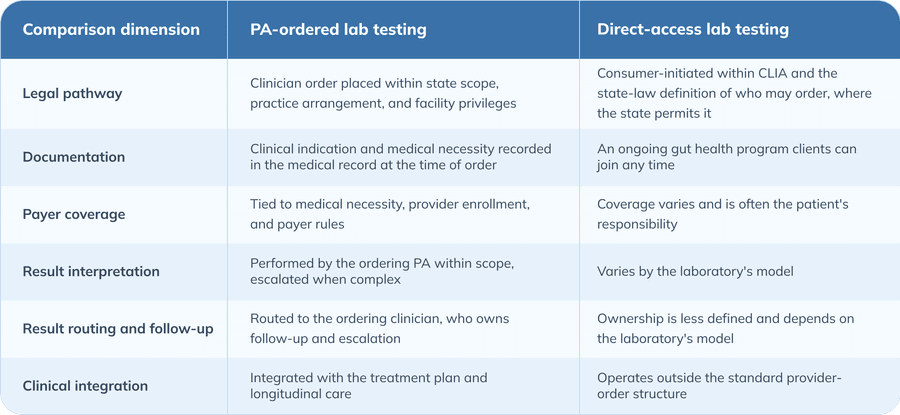
Provider-ordered testing and direct-access testing follow different routes from order to result, with different documentation and follow-up. This chapter compares the two without treating direct access as a substitute for clinically indicated evaluation.
Provider-ordered testing pathway
In the provider-ordered pathway, a clinician assesses the patient, documents a diagnostic rationale, places the order, interprets the result, and manages follow-up. Medicare's framework reflects this sequence, with the treating practitioner ordering the test and using the result in management. (7)
This pathway integrates testing with treatment decisions and longitudinal care. Keep the rationale, interpretation, and follow-up in the record so the order connects to a care plan and supports the eventual claim.
Direct-access laboratory testing pathway
Direct-access testing lets a consumer initiate testing without the same provider-order structure, within CLIA and the state-law definition of who may order. (4) State law and laboratory policy vary in what direct access permits.
Direct access carries different follow-up, interpretation, documentation, and payer implications than a provider order. Confirm what your state and the laboratory allow for direct access before relying on it for a clinical question.
Decision-relevant comparison for clinics and ordering platforms
The choice between the two pathways comes down to legal route, payer coverage, result interpretation, abnormal-result follow-up, documentation burden, and clinical integration. Federal guidance places direct-access testing within the CLIA framework under its own state-law and result-reporting conditions. (4)
The practical question for a clinic is when a provider order is warranted. Reserve clinically indicated evaluation for a provider-ordered pathway, and treat direct access as one option within a workflow rather than a replacement for it.
Practical verification algorithm before using a physician assistant lab order
This chapter is a four-step verification sequence to run before relying on a PA lab order. Each step gates the next, so an order proceeds only when scope, lab acceptance, payer conditions, and follow-up are all confirmed.
Step 1: Verify state scope and practice authority
- Confirm the current state PA practice law and board guidance before relying on the order, since scope is set by state law among other parameters. (1)
- For a telehealth order, confirm that the PA holds authority in the state where the patient is located. (8)
- Review the practice agreement, collaboration or supervision requirements, credentialing file, and facility privileges.
- Confirm that the ordered test fits the PA's licensed scope, clinical role, specialty context, and practice setting.
- Move ahead only once those checks support the order, and resolve anything unsettled first.
Step 2: Verify laboratory acceptance and requisition requirements
- Check that the lab accepts PA orders for the test you are ordering.
- Make sure the requisition carries everything the CLIA test-request standard requires, including the ordering PA's name and contact details, the diagnosis, the order format and signature, and the fields that route the result. (10)
- For specialty, proprietary, or restricted tests, find out whether the lab wants extra documentation or a review step.
- Fix any gaps in the requisition before the specimen is collected or sent to an outside lab.
Step 3: Verify payer, medical necessity, and coverage conditions
- Ask the payer what it expects for a PA-ordered test, such as whether the PA is enrolled and in network, whether prior authorization applies, and what documentation supports medical necessity.
- Distinguish Medicare, Medicaid, commercial, Medicare Advantage, managed care, and self-pay pathways, recognizing that Medicaid rules vary by state. (5)
- Tie the order to a specific clinical problem, diagnostic question, monitoring need, or management decision, consistent with the Medicare medical-necessity standard. (7)
- Keep coverage guarantees out of patient communications, clinic policy materials, and ordering-platform workflows.
Step 4: Verify result routing, follow-up, and escalation ownership
- Identify who receives, reviews, interprets, and communicates results.
- Set the thresholds that trigger escalation for an abnormal, critical, conflicting, or time-sensitive result, and capture them in written critical-result procedures. (9)
- Know who the PA turns to, a collaborating physician, specialist, or on-call clinician, when a result goes beyond what the PA or the setting can handle.
- Have closed-loop tracking running before the draw or the outside referral, so a result does not slip through unreviewed. (3)
Common misconceptions about physician assistant lab orders
Several recurring misconceptions about PA lab orders contribute to confusion, delays, and avoidable denials. This chapter corrects each one.
Misconception that only physicians can order lab tests
PAs may order many labs when state law allows it, the test is within scope, and the laboratory accepts the order. Medicare extends ordering to nonphysician practitioners within state scope, and CLIA defines the authorized person by state law rather than by physician status. (7) The qualified-practitioner pathway is real and remains bounded by state law.
Assuming a physician-only requirement delays care and misroutes valid orders. Confirm the PA pathway for the specific state and test rather than defaulting to physician-only.
Misconception that PA orders are automatically covered
An order from a PA does not make a test automatically covered, because payment also turns on medical necessity, documentation, the PA's enrollment with the payer, and the plan's rules. Medicare pays based on medical necessity and the treating-practitioner standard rather than on the order alone, and Medicaid and commercial plans add their own conditions. (7)
Conflating a valid order with payment approval drives denials and patient billing disputes. Verify coverage conditions for each payer before testing.
Misconception that any ordered lab is clinically justified
An order should connect to a clinical problem, diagnostic question, monitoring need, or management decision. Overutilization and non-directed panels are quality and billing risks, with overuse concentrated at initial ordering. (11) Medicare reinforces this by tying payment to a test used in managing a specific problem. (7)
Evidence-aligned ordering reduces waste, denials, and downstream error. Document the indication and intended use of the result for each test, and pair ordering with follow-up.
Frequently asked questions (FAQs)
Can a physician assistant order blood tests in urgent care?
A PA can typically order routine blood tests in urgent care when the order falls within their scope and the facility grants the privilege. Confirm the state rule and the site's credentialing before treating it as automatic.
Can a PA order labs without a supervising physician physically present?
In many states a PA can order labs without a physician on site, though some still require a co-signature or a collaborative agreement. It depends on the state and how the practice is set up.
Can a physician assistant order diagnostic testing for Medicare beneficiaries?
Yes. Medicare lets a PA order diagnostic tests within their state scope, as long as the test is medically necessary and the result informs how they care for the patient.
Can a PA order hormone testing, genetic testing, or specialty lab panels?
A PA may order specialty panels when they fall within demonstrated scope and the laboratory and payer requirements are met. Genetic and proprietary tests often require specific diagnosis codes, prior authorization, or added documentation.
Can a PA order sexually transmitted infection testing?
In most settings a PA can order sexually transmitted infection (STI) testing as part of routine evaluation within scope. State law and facility policy govern the specifics.
Can a PA order labs through a telehealth visit?
Yes, when the PA holds authority in the state where the patient is located and the laboratory accepts the order. Telehealth visits are generally treated as occurring in the patient's state.
Is a PA lab order processed the same way as a physician lab order?
A PA order is processed like a physician order once the laboratory confirms the PA is an authorized person under state law and the requisition fields are complete. Missing identifiers or unverified authority cause many delays.
What documentation should support a PA-ordered laboratory test?
The record should show the clinical indication, the medical necessity, and how the result will be used in management, along with the ordering PA's identifiers on the requisition.
Who is responsible for reviewing abnormal results from a PA-ordered lab?
Assign that ahead of time, usually to the ordering PA, with a clear route to escalate to a physician or specialist when needed. Closed-loop tracking is what keeps a result from slipping through unreviewed.
When should a PA escalate laboratory findings to a physician or specialist?
Escalate when a result is critical, when it does not add up or falls outside the PA's specialty, or when confirming or interpreting it needs specialist input.
The bottom line
The most reliable way to handle a PA lab order is to treat it as a regulated clinical workflow rather than a single yes-or-no question. Before you implement or communicate PA lab-ordering workflows, review your current state PA practice rules, credentialing policies, payer documentation requirements, and laboratory requisition standards.
Ready to start delivering better patient care?
Join 125,000 healthcare providers who rely on Fullscript to dispense top-quality supplements and labs to their patients.