Cortisol Levels by Age: How Stress Hormones Change Over Time


Cortisol is often called the stress hormone, but it does much more than help you handle a tough day. It helps control your blood sugar, blood pressure, sleep, and swelling in the body. Your cortisol levels also change as you grow up, have children, and get older.
This guide explains what normal cortisol looks like, how it shifts from childhood to older age, and what you can do to keep it in a healthy range. You'll also learn the signs that your cortisol may be too high or too low, and when to talk to a provider.
Key takeaways:
- Cortisol is a hormone made by your adrenal glands. It helps your body respond to stress and controls blood sugar, blood pressure, and sleep.
- Cortisol follows a daily rhythm. It's highest in the morning and drops through the day.
- Normal cortisol rises during the teen years. During pregnancy, it rises to two to three times its usual level.
- Unlike many hormones, cortisol tends to rise, not fall, as you get older.
- Long-term high cortisol is linked to high blood pressure, weight gain, poor sleep, and depression.
- Sleep, exercise, a balanced diet, and strong relationships can help support healthy cortisol levels.

Health is a journey. Find your guide.
Fullscript Connect helps you find a healthcare provider that partners with you — from where you are now to where you want to be. Easily explore profiles and pricing, find the right fit, and book today.
What is cortisol?
Cortisol is a hormone made by your adrenal glands. These are two small glands that sit on top of your kidneys. Hormones are chemical messengers. They travel through your blood and tell your organs what to do. (2)
Cortisol affects almost every organ and tissue in your body. It helps:
- Control how your body uses sugar, fat, and protein for energy
- Keep your blood pressure steady
- Manage swelling (inflammation)
- Set your sleep-wake cycle
- Guide your body's response to stress (2)
Your body keeps a close watch on cortisol to try to keep it at a healthy level. When levels stay too high or too low for too long, health problems can follow. (2)
What are normal cortisol levels?
Normal cortisol depends on the time of day. Levels peak shortly after you wake up and are lowest around midnight. For most blood tests, typical cortisol ranges are as follows. (15)
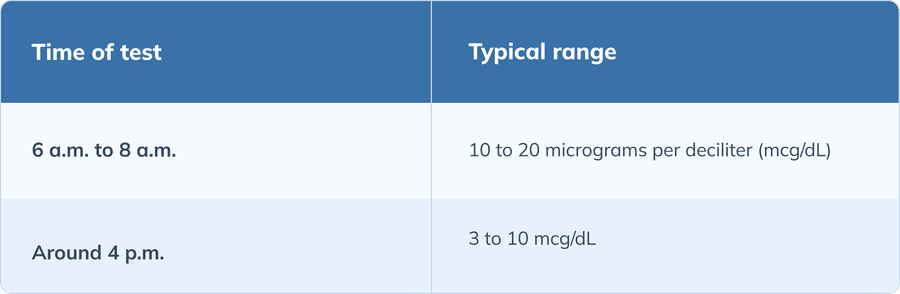
Ranges can vary a little from lab to lab. That's why your provider will compare your result to the range your lab uses. A single cortisol test also can't tell you why a level is off. Your provider may order more tests to find the cause. (12)
How cortisol levels change with age
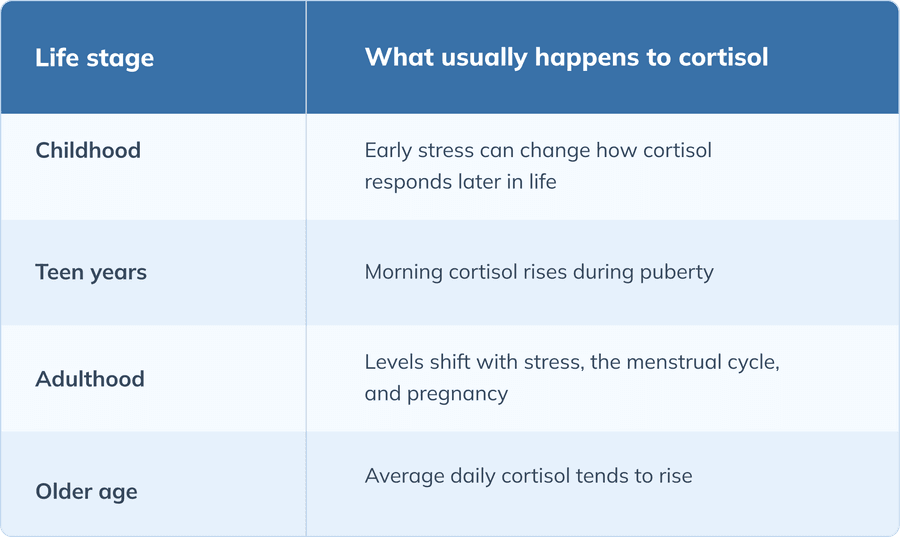
Cortisol isn't fixed for life. It shifts with your age, your stage of life, and what you've been through. Here's a quick look at each stage.
Cortisol levels during childhood
The way your body handles cortisol starts to form early in life. Stress in the first years of life seems to matter. In one study of more than 1,000 babies, higher cortisol at 15 months was linked to lower scores on tests of thinking and learning. (5) This shows a link, not proof, that cortisol caused the lower scores associated with early cognitive development.
Hard experiences in childhood may also have lasting effects. Adults who went through trauma as children tend to show different cortisol responses to stress. (4) This is one reason why a safe, stable home helps kids stay healthy.
Cortisol levels during teen years
Cortisol naturally climbs during puberty. Research shows that resting morning cortisol rises between ages 13 and 16:
- Boys: from 10.7 mcg/dL at age 13 to 14.4 mcg/dL at age 16
- Girls: from 11.1 mcg/dL at age 13 to 15.9 mcg/dL at age 16 (19)
This rise is a normal part of growing up. But cortisol also plays a role in teen mental health. A review of many studies linked higher cortisol levels to the development of depression in teens and young adults. (18)
Cortisol levels during adulthood
In adulthood, work, money, family, and parenting can all raise stress. In the short term, cortisol helps you. It powers your "fight or flight" response so you can react quickly to a threat. (6)
Problems start when stress doesn't let up. Over time, high cortisol may contribute to:
- High blood pressure
- Buildup in the arteries (the blood vessels that carry blood from your heart)
- Weight gain
- Poor sleep
- Anxiety and depression (6)
Cortisol, periods, and pregnancy
Women's cortisol levels also shift with the menstrual cycle. The phase of your cycle may change how the body makes cortisol to respond to stress. (10) One study found that the rise in cortisol after waking was higher around ovulation, the point in the cycle when an egg is released. (16)
Pregnancy has an even bigger effect. Cortisol rises two to three times higher over the course of a normal pregnancy. (13) This rise is expected and plays a role in the baby's development. But levels that run higher than usual may be a concern. In a study of pregnant women in India, higher cortisol was linked to lower birth weight, lower weight for length in newborns, and more signs of depression in mothers after birth. (14)
Cortisol levels during older age
Many hormones drop as you age. Cortisol usually goes the other way. Average daily cortisol tends to rise in older adults, while the normal daily rhythm stays mostly the same. (17)
Higher cortisol in later life may affect the brain and body. It's been linked to memory problems, poor sleep, muscle loss, high blood pressure, weaker bones, belly fat, and diabetes. (17) Older adults may also have a harder time bouncing back from stress, which can raise the risk of mood and memory problems. (7)(17)
What affects your cortisol levels?
Age is only one piece of the puzzle. Many other things can push cortisol up or down, including:
- Ongoing stress at work or at home
- Stressful or traumatic events in childhood
- Poor sleep
- Health conditions that affect the adrenal or pituitary glands
- Certain medicines (2)(4)(6)
Health conditions and medicines
Some conditions and medicines have a big effect on cortisol. Common causes of high or low cortisol include:
- Taking steroid medicines (corticosteroids) in high doses for a long time, such as for asthma or arthritis
- Tumors that make adrenocorticotropic hormone (ACTH), a hormone that tells the adrenal glands to make cortisol
- Tumors in the adrenal glands
- Damage to the adrenal glands from autoimmune disease or infection (12)
If you have a condition that affects your hormones, regular checkups with your provider can help catch changes early.
Signs your cortisol may be too high or too low
Most changes in cortisol are mild. But two conditions cause more serious problems. Both need care from a provider.
Signs of high cortisol (Cushing syndrome)
Cushing syndrome happens when your body has too much cortisol for a long time. Signs include:
- Weight gain around the belly and upper back
- A rounder face
- A fatty hump between the shoulders
- Thin arms and legs
- Easy bruising
- Pink or purple stretch marks on the belly, thighs, breasts, or arms
- Muscle weakness (9)
Signs of low cortisol (Addison's disease and adrenal insufficiency)
Adrenal insufficiency happens when your adrenal glands don't make enough cortisol. When the adrenal glands themselves are damaged, it's called Addison's disease. (11) Addison's disease is rare. It affects about 100 to 140 of every million people in developed countries. (11)
Signs of low cortisol include:
- Ongoing tiredness
- Loss of appetite
- Weight loss
- Belly pain
- Muscle weakness
- Dark patches of skin (1)
Low cortisol can sometimes cause a sudden, life-threatening problem called adrenal crisis. Get emergency care right away if you have severe weakness, confusion, severe belly pain, or vomiting, especially if you already have adrenal insufficiency. (1)(11)
How is a cortisol problem diagnosed?
To check your cortisol, your provider will ask about your health history and symptoms and do a physical exam. They may also order lab tests. Cortisol can be measured in blood, urine, or saliva. (2)(15)
Because cortisol changes during the day, the timing of your test matters. Your provider may ask you to test at a set time, collect urine over 24 hours, or take a saliva sample late at night. (8)(15)
How to support healthy cortisol levels
You can't avoid stress completely. But daily habits can help your body handle it better. (3) These steps may help keep cortisol in a healthy range:
- Get enough sleep. Aim for a regular bedtime and wake time.
- Move your body. Regular exercise helps your body manage stress.
- Eat a balanced diet. Focus on whole foods like vegetables, fruit, whole grains, and lean protein.
- Try relaxation methods. Deep breathing, meditation, or yoga can help calm your stress response.
- Stay connected. Strong relationships with friends and family help protect against stress. (3)
Healthy habits support your body, but they can't fix every cortisol problem. Some causes, like tumors or adrenal damage, may require medical care.
Treatment options for cortisol imbalance
Treatment depends on what's causing the problem. Your provider may suggest:
- Lifestyle changes to lower stress and support better sleep
- Changing medicines or doses, such as slowly lowering steroid medicines under a provider's care
- Hormone replacement medicine for people whose bodies don't make enough cortisol
- Surgery or radiation therapy to treat a tumor that's causing high cortisol (1)(8)
Frequently asked questions (FAQs)
What is a normal cortisol level by age?
There's no single normal level for each age. For most adults, a normal morning blood test is 10 to 20 mcg/dL, and a 4 p.m. test is 3 to 10 mcg/dL. (15) Teens tend to have rising morning levels during puberty, and older adults tend to have higher average daily levels. (17)(19)
Does cortisol go up or down with age?
Cortisol usually goes up with age. Unlike many other hormones, average daily cortisol tends to rise in older adults. (17)
What time of day is cortisol highest?
Cortisol is highest in the early morning, shortly after you wake up. It slowly drops through the day and is lowest around midnight. (15)
Why does cortisol go up during pregnancy?
Cortisol rises two to three times higher during a normal pregnancy. This is expected and helps support the baby's growth. (13) Your provider will keep an eye on your health during pregnancy.
Can I lower my cortisol naturally?
Healthy habits may help support normal cortisol. These include getting enough sleep, exercising, eating a balanced diet, using relaxation methods, and spending time with people you care about. (3) If you think your cortisol is too high or too low, talk to your provider before making changes.
When should I see a provider about my cortisol?
See a provider if you have signs of high or low cortisol, such as unexplained weight changes, ongoing tiredness, easy bruising, or muscle weakness. Get emergency care for severe weakness, confusion, severe belly pain, or vomiting. (1)(9)
The bottom line
Cortisol changes across your whole life. It rises in the teen years, jumps during pregnancy, and tends to climb again in older age. Short bursts of cortisol help you handle stress. But high or low levels that last a long time can affect your heart, weight, mood, and sleep.
Good sleep, regular exercise, a balanced diet, and strong relationships can help support healthy cortisol. If you notice signs that your cortisol may be off, talk to your provider. A simple lab test is often the first step toward answers and a plan that fits you.
Health is a journey. Find your guide.
Fullscript Connect helps you find a healthcare provider that partners with you — from where you are now to where you want to be. Easily explore profiles and pricing, find the right fit, and book today.